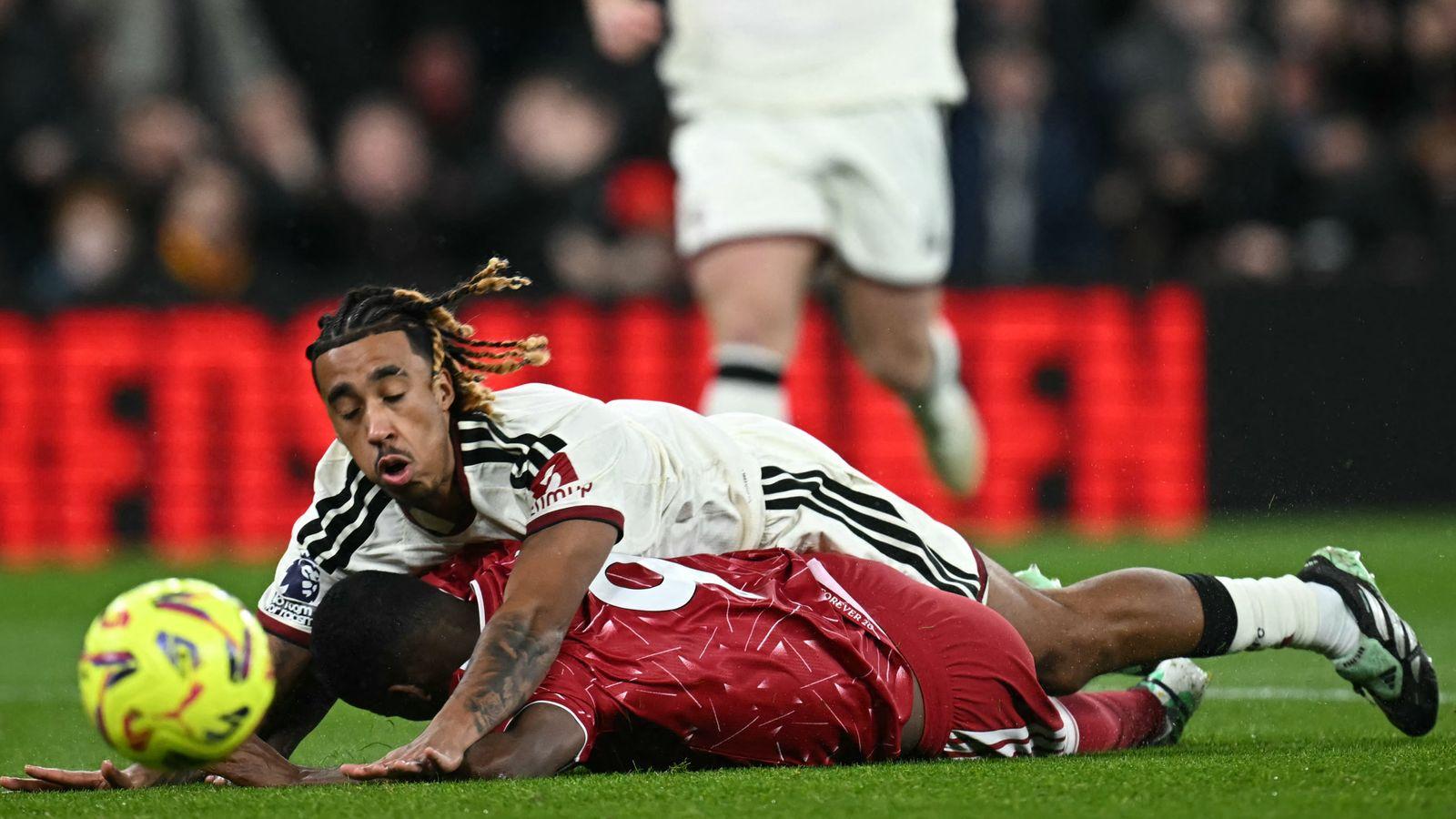
The Football Association has published its written reasoning for overturning Leny Yoro's red card in Manchester United's defeat at Liverpool, a decision that contradicted the assessment of Pro Ref's refereeing leadership. According to Sky Sports, the FA's three-person independent panel determined that referee Sam Barrott and VAR John Brooks had committed an "obvious error" when dismissing the defender for denying an obvious goalscoring opportunity.
Yoro was sent off after bringing down Liverpool striker Alexander Isak as the last defender outside the penalty area. Barrott issued the red card for DOGSO, with Brooks supporting the on-field decision. Yet despite Pro Ref chief Howard Webb indicating that no clear mistake had been made, the FA still chose to overturn the dismissal on the grounds that Isak was not in possession of the ball when fouled.
The three-member panel—comprising former Blackburn and Middlesbrough winger Stuart Ripley, former Sheffield United and Notts County forward Tony Agana, and former Walsall goalkeeper Mick Kearns—examined the incident in detail and concluded that Isak had lost control of the ball after taking a heavy touch.
In their formal statement, the commission members explained their unanimous finding:
The Commission members were unanimous that, taking the foul committed by Yoro out of the scenario, Isak would not have had an obvious goal-scoring opportunity.
The panel elaborated on their reasoning, noting that despite Isak reaching the ball initially, his touch was poor enough that he had effectively surrendered possession.
Despite the fact that Isak had reached the ball initially, his touch was heavy to the extent that he had in fact lost control of the ball - that control had, in effect, passed to the advancing MUFC goalkeeper who in the view of the Commission would have been able to gather or smother the ball before AI [Alexander Isak] could get to it and shoot at goal.
The commission concluded:
To the mind of the Commission, the referee had made an 'obvious error' in deciding that AI would have had an obvious goal-scoring opportunity.
Manchester United's appeal submission included extensive supporting material to challenge the dismissal. The club provided three separate camera angles of the incident and also submitted footage of Pascal Struijk's red card for Brighton against Sunderland—a case that was similarly overturned on appeal. United's analysis contended that Isak would have been at least 1.8 metres short of the ball without Yoro's challenge. The FA acknowledged this claim but stated it could not independently verify the measurement, so the analysis was
viewed with caution and allocated weight accordingly.
United's appeal succeeded at a critical moment for the club, which conceded four goals in the heavy defeat to Liverpool. The FA confirmed Yoro's one-match suspension was removed after the wrongful-dismissal appeal succeeded, restoring his eligibility for upcoming fixtures.
Webb's perspective on the incident
In the latest edition of Match Officials Mic'D Up, Pro Ref chief refereeing officer Webb offered a measured assessment of the officials' handling of the moment, though he stopped short of endorsing the dismissal outright.
By and large most people would see that as a correct decision with Isak moving quickly on towards that ball. The alternative view is that Lammens might get there first, but it's a little bit debatable, I guess. Certainly not clearly wrong.
Audio from the officials revealed that VAR Brooks, who had backed Barrott's decision, determined Isak was
likelyto reach the ball before goalkeeper Lammens. His assistant VAR, Paul Howard, concurred with this assessment.
The Struijk precedent and ongoing divisions
The Yoro case is not the first time this season that a DOGSO dismissal has created friction between different levels of football's refereeing hierarchy. In October, two independent panels reached conflicting conclusions over whether Brighton's Struijk deserved to be sent off at Sunderland—a case that United strategically referenced in their evidence.
Struijk was dismissed for denying an obvious goalscoring opportunity when he fouled Sunderland striker Wilson Isidor as the ball ran through to goalkeeper Bart Verbruggen. Neither referee Thomas Bramall nor his assistant initially flagged a foul, but VAR Neil Davies intervened and recommended an on-field review. After watching replays, Bramall changed his decision and sent Struijk off.
Brighton appealed and an independent regulatory commission overturned both the red card and the subsequent one-match ban. However, disagreement persisted when the Key Match Incidents (KMI) panel—a separate independent body tasked with evaluating refereeing decisions—voted 3-2 that the VAR intervention had been correct. The KMI panel ruled that Struijk committed a
cynical foul clearly impacting the attacker's ability to gain possession of the ball which should have been penalised by the referee.
What happens next
Manchester United are scheduled to host Brentford in the Premier League on Saturday, 28 November 2026, with Yoro now available for selection after his suspension was removed. The defender's return to the squad comes as United seek to rebuild following the heavy defeat at Anfield.