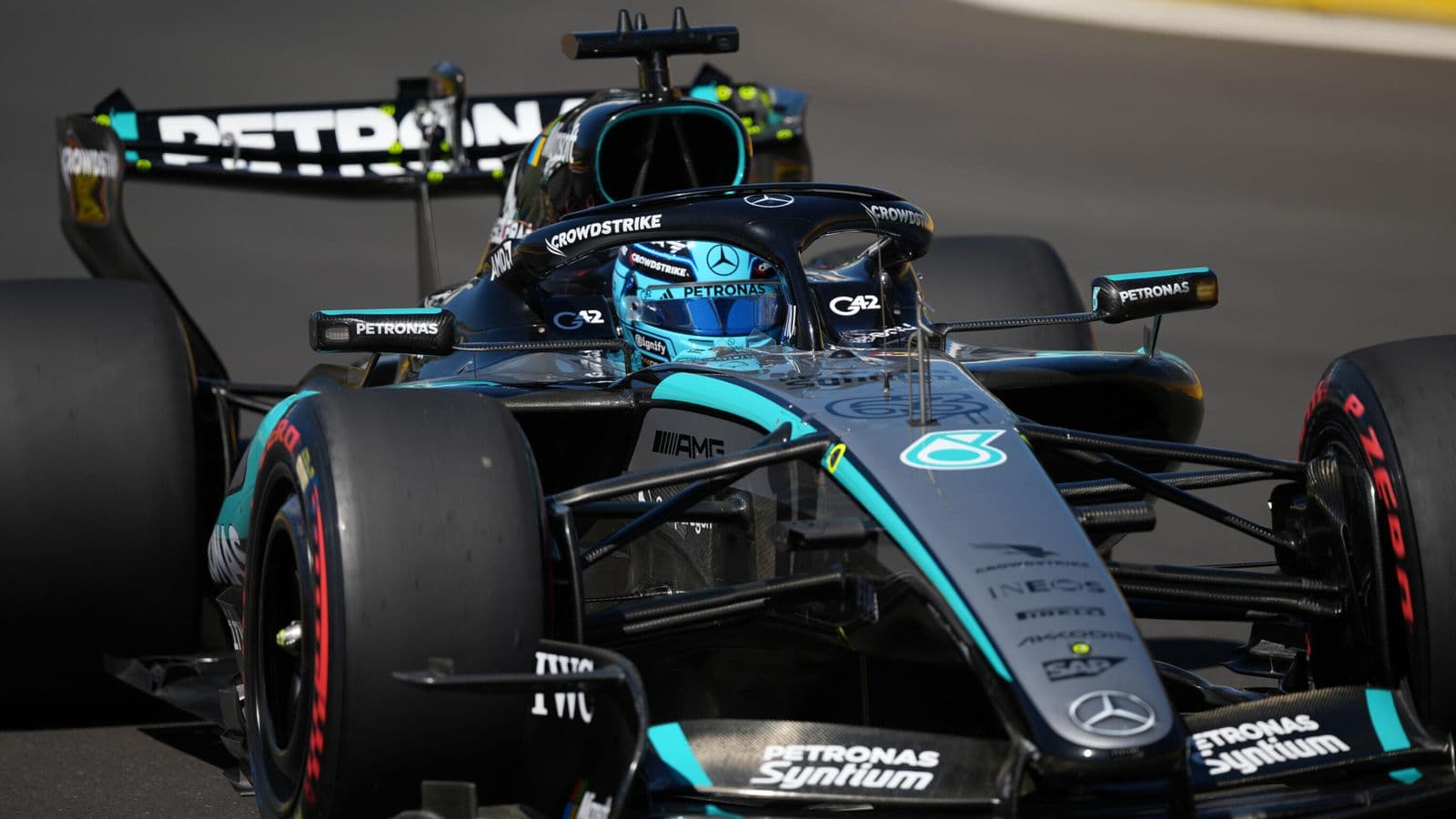
George Russell has flagged serious concerns about tyre degradation ahead of Sunday's Spanish Grand Prix following the opening day of track action at Madrid's new Madring circuit. The Mercedes driver topped the opening practice session and witnessed firsthand the punishing demands the high-speed layout places on rubber compounds.
The circuit's distinctive characteristics, particularly the steeply banked Turn 12 known as La Monumental where drivers maintain enormous velocity through a 13.5-degree banking, are extracting a heavy toll on tyre performance. Russell's observations during Friday's running painted a stark picture of the challenge ahead.
There's a big question mark over the tyre degradation. In FP1 with the tyre degradation we all had, we thought a six-stop race would be the fastest way!Russell remarked with a hint of humour, before adding more seriously:
I'm sure tyre degradation will be better on Sunday but with the big long La Monumental, it really hurts the tyres and that will be a challenge for everyone.
Russell's Mercedes team-mate Kimi Antonelli set the pace in second practice, positioning the Silver Arrows as early frontrunners at a circuit making its World Championship debut. The event marks Madrid's return to Formula 1 after 45 years, with the 5.4-kilometre circuit requiring 57 laps to complete the race distance.
Saturday's qualifying session at 3pm, broadcast live on Sky Sports F1, will prove decisive given the anticipated difficulty of overtaking around the Madrid layout. Track position at the start could prove crucial to race strategy.
Mercedes technical concerns over thermal effects
Bradley Lord, Mercedes' deputy team principal, confirmed that the combination of extreme heat on the Madrid circuit and the relentless sequence of corners presents a genuine puzzle for teams heading into Sunday's race. The lack of extended straights means tyres receive minimal opportunity to cool between high-speed corners.
You could see some unusual tyre effects because they are running so hot and you have a lot of cornering sequences without a real chance for the tyres to have a breather,Lord explained.
It's corner after corner after corner. How the tyres cope with that will be decisive. Even though it's a smooth surface and tyre wear may not be as high as we expect, we may see some other thermal effects that the computers beforehand might expect you to make.
The technical challenge extends beyond simple wear rates. The continuous cornering demands and elevated temperatures could trigger unexpected thermal behaviour that pre-event simulations may not have fully captured, adding another layer of uncertainty to race planning.
Ferrari adjusts approach after Friday learnings
Ferrari emerged as Mercedes' closest challengers during Friday's running, with Charles Leclerc and Lewis Hamilton both within two tenths of Antonelli's second practice benchmark. However, the Scuderia identified areas requiring adjustment before qualifying and the race.
Leclerc, still searching for his first pole position of the season, acknowledged the novelty and complexity of the venue.
It's been a very interesting day. A completely new track for everyone and it's very challenging. I think Qualifying will be an exciting one,the Monégasque driver said.
Lots of work ahead of us to try to improve the car for tomorrow but the day went well. We went through our programme and maximised the amount of laps we could do, which was one of the main targets.
Both Ferrari drivers encountered difficulties navigating the downhill braking zone at Turn 17, locking up multiple times during the session. Team principal Frederic Vasseur attributed these issues partly to the constantly evolving track conditions as the surface evolved throughout the day.
Vasseur also signalled a strategic shift in Ferrari's preparation. While long-run pace proved respectable, the team recognised that single-lap performance in qualifying would carry disproportionate weight given the overtaking difficulties expected during the race.
The long stint was as expected. It's mega difficult to overtake. It means that the positions on track at the start will be crucial,Vasseur stated.
It means also that we have to change a little bit the focus. For sure, it's better to have good pace for the race, but the position in qualifying will be it. Overall it was a decent Friday.
The Ferrari principal's comments underscored a fundamental reality of racing at the Madring: securing a strong grid position through qualifying has become arguably the single most important factor in determining race outcome, given the circuit's resistance to overtaking manoeuvres.
What happens next
Qualifying takes place on Saturday 12 September at 16:00 local time, with third practice running earlier in the day. The Spanish Grand Prix race itself begins on Sunday 13 September at 15:00 local time, with build-up coverage starting at 12:30pm on Sky Sports F1. The weekend's schedule also includes support series races and the traditional drivers' parade before the main event.
Formula 1's return to Madrid after four and a half decades promises to test the sport's finest in ways few circuits can match. The combination of extreme speed, thermal challenges, and limited overtaking opportunities means that Friday's practice sessions have already established the broad parameters within which teams must operate. How effectively they adapt their strategies to manage tyre degradation and thermal effects over the race distance could ultimately determine who stands atop the podium on Sunday evening.